

French herringbone: an elegant floor pattern for contemporary interiors
French herringbone: an elegant floor pattern for contemporary interiors.

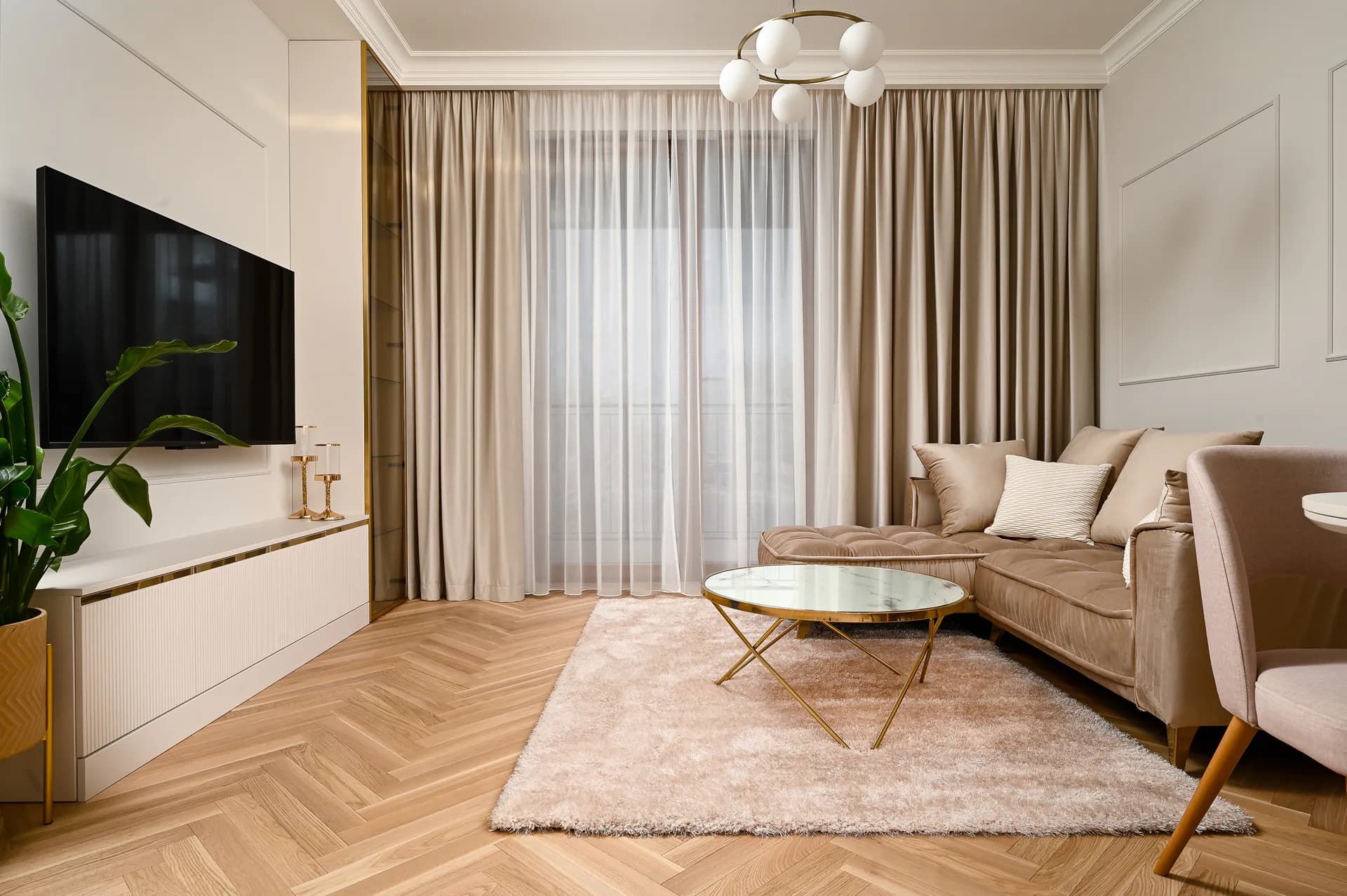
Classic herringbone is one of the most timeless flooring patterns, one that has for years found its place in both traditional and modern living rooms. The distinctive arrangement of boards at a 90-degree angle gives interiors elegance, order and a unique character, and current interior design trends are once again returning this pattern to the ranks of the most popular solutions used in houses and apartments.
A wooden floor is a timeless element of interior design that brings warmth and natural character into rooms. One of the most elegant and striking patterns is French herringbone, which, thanks to the precise arrangement of the boards, creates a unique, dynamic pattern. Laying boards in this way not only highlights the beauty of the wood, but also gives an interior exceptional style and harmony.
Classic herringbone is a traditional parquet pattern that has been enjoying a genuine renaissance in Polish living rooms in recent seasons. Rectangular boards laid at right angles create a distinctive point resembling the letter V – a solution that gives any interior an inimitable character and elegance.
The classic herringbone pattern is created by laying the boards so that the shorter edge of one block meets the longer edge of the next at a 90-degree angle
Herringbone flooring is back in favour in living room arrangements in townhouses, new builds and lofts, particularly in oak versions
Trends for 2025-2026 point to the popularity of light oak shades and wider board formats
This article is informative in character – it describes trends, history and arrangement possibilities without ranking the solutions
The content is aimed both at interior designers and at flat owners planning a living room with a wooden floor
A wooden floor laid in the classic herringbone pattern is one of the most recognisable designs in the history of interior architecture. This classic parquet has its roots in the days of the Roman Empire, where a similar arrangement of boards was used in road building.
Rectangular boards or blocks joined so that the shorter edge of one meets the longer edge of the next at a right angle
A rhythmic layout creating a distinctive point and a pattern resembling arrows or the letter V
Symmetrical geometry that highlights the natural beauty and grain of the wood
Classic herringbone is also known as English herringbone, or simply herringbone. In a living room, this pattern introduces a regular rhythm that visually brings order to the interior. It works beautifully with the long axes of a room, which means it performs superbly in intimate living rooms and expansive open-plan zones alike.
The years 2025-2026 are seeing a marked return of parquet and herringbone panels in new flats in Warsaw, Krakow and Wroclaw. After a period dominated by straight floorboards, designers are increasingly reaching for this classic pattern.
Light oak shades – natural, Scandinavian and whitewashed oak brighten the living space
Herringbone on a larger scale in big living rooms with an open-plan kitchen (25-40 m²)
Combinations with smooth walls in whites, beiges and greys
Low-profile modular sofas and simple tables to complete the arrangement
Modern arrangements clearly reference the atmosphere of 1920s and 1930s townhouses and of flats from the 1950s and 1960s. Designers combine the herringbone pattern with vintage furniture, steel elements and decorative mouldings. One example of this trend is the return of Józef Chierowski's 366 armchair, which fits perfectly into the aesthetics of contemporary living rooms with classic parquet.
The popularity of classic herringbone in modern interiors stems from the search for a balance between tradition and modernity. Oak remains the dominant species thanks to its durability and the aesthetic depth of its grain.
The dimensions of the boards significantly influence how the pattern reads in a living room. The proportions of the blocks determine whether the wooden floor will feel more traditional or more contemporary.
| Format | Use | Visual effect |
| 70 × 490 mm | Townhouses, smaller living rooms | Fine, jewel-like pattern |
| 120 × 600 mm | New apartments | Balanced, universal |
| 150 × 750 mm | Larger living rooms | Calm, modern |
| 180 × 900 mm | Open-plan zones | Highlights the oak grain |
Smaller blocks echo traditional townhouse parquet, creating a subtle rhythm that is ideal for intimate spaces. In new apartments, 120 × 600 mm formats are common, offering a natural look without overwhelming the interior.
Designers most often choose finer dimensions for living rooms in blocks of flats (16-20 m²), and wider formats for large living rooms with an open-plan kitchen. The boards are usually laid perpendicular to the window or to the longer wall, which makes the most of the pattern's dynamic effect.
The same classic herringbone pattern can be achieved with either solid or engineered boards. The difference lies in the construction, not in the geometry of the layout – both options are real wood and deliver an authentic effect in the living room.
A single piece of wood through its full thickness (usually 15-22 mm)
A thicker wear layer that allows repeated sanding
A more artisanal character with visible natural imperfections
More often chosen for period townhouse arrangements
A top layer of fine wood (2-6 mm of oak) bonded to a stabilising backing
Less susceptibility to changes in moisture and to deformation
Easier installation in modern flats
Often preferred in systems with underfloor heating
Visually, both constructions produce a similar effect in the living room. The final impression of the floor depends more on the colour, grain and surface treatment than on the construction of the boards itself.
The visual effect in a living room is shaped not only by the pattern itself but also by the way the wood is finished. The choice of floor covers various options for colour, level of sheen and surface texture.
Lacquered – semi-matt for depth of colour, matt or super-matt for a natural, velvety feel; high resistance to scratches
Oiled/oil-waxed – soak into the wood, accentuate the grain and require periodic renewal; they create a warm, organic sense of cosiness
Brushing – removes the soft fibres, exposing the texture of the grain for tactile depth
Edge bevelling – creates a delicate V along the joints, reinforcing the pattern's broad arrowhead
Manufacturers offer both raw blocks for on-site lacquer finishing and ready-made, factory-sealed elements. The 2025-2026 trends are dominated by matt finishes, which sit well with natural, uncluttered living room arrangements – a fine example being the lacquered Kaczkan Baltic Seaside engineered board.
Classic herringbone works as a versatile backdrop for many styles – from period to highly contemporary. Its symmetry and calm make it an excellent choice for anything from elegant studies to open-plan living areas.
Oak in a natural or slightly honeyed shade
Furniture on turned legs, simple forms
References to PRL-era aesthetics and modernism
A coffee table with geometric shapes
Light whitewashed oak, walls in off-white
Textiles in greys and beiges for lightness
Minimalist low-profile sofas
Accents in natural materials
Smoked oak with pronounced grain
Dark window frames and steel shelving
Raw finishes, exposed brick
A contrast between the warmth of wood and the coolness of metal
Warm oak or a slightly darkened finish
Wall mouldings lending the interior elegance
Large sofas and crystal chandeliers
The pattern's historic pedigree reinforcing the sense of authenticity
It is worth considering the character of your interior before choosing the shade and format of the boards – classic herringbone adapts to each of these styles, and inspiration can be found in completed wooden floor projects.
Classic herringbone exists alongside other variants, which differ mainly in the cutting angle of the boards and the visual effect. All belong to the herringbone family of patterns and allow you to design an interior around your own concept.
| Pattern | Characteristics | Effect |
| Classic | Right angle (90°), straight ends | Symmetrical zigzag |
| French | Ends cut at a 45-degree angle | Sharp, continuous zigzag |
| Hungarian | Cuts at 60° | Flattened arrowhead |
The French herringbone pattern is characterised by boards cut at a 45-degree angle at the ends, creating a refined, continuous zigzag with a sharper rhythm. Hungarian herringbone offers yet another flow – a more dynamic effect thanks to its different cutting angle.
Installing classic herringbone is less demanding than French herringbone, but it still requires precision and proper preparation.
The classic herringbone pattern can look superb even in smaller living rooms of 16-20 m². In such spaces, light oak shades and a finer block format work well, visually enlarging the room. Laying the boards along the longer axis, or perpendicular to the window, enhances the sense of spaciousness. It is worth consulting a designer on the laying direction in relation to the light source and the main axes of the living room.
Two approaches are possible – a similar wood tone (for example oak with walnut) creates a calm, harmonious interior, while contrast (a light herringbone with dark veneer or black metal) delivers a bolder, more dynamic effect. Pairing an oak floor with furniture in white or grey, or with steel elements, is popular. An excellent way to liven up an arrangement is to introduce accents in a different colour while keeping the base consistent.
Designers often use this pattern in open-plan living areas of the living-room-with-kitchen type. The herringbone leads the eye through the whole interior, linking the seating area with the dining space and kitchen. Subdued floor colours work well with the finish of the kitchen cabinetry. In such spaces (25-40 m²), wider board formats look particularly good.
Light oak pairs well with off-whites, beiges and light greys – together they create a harmonious, light-filled interior. Darker oak calls for lighter walls to balance the intensity of the floor. The 2025-2026 trends also favour delicate shades of green and clay beiges. Floor panels in darker tones can also be set against white for a striking contrast.
The classic herringbone pattern is also reproduced by laminate and vinyl panels from herringbone collections. They offer a similar visual effect at a lower price and with easier installation. They differ, however, in material, durability and authenticity – these products cannot provide the warmth or depth of real wood. The choice depends on your aesthetic expectations, budget and the character of the home. For those who value the inimitable character of natural materials, a traditional board remains an excellent choice.
We will advise and prepare an individual quote matched to your interior.
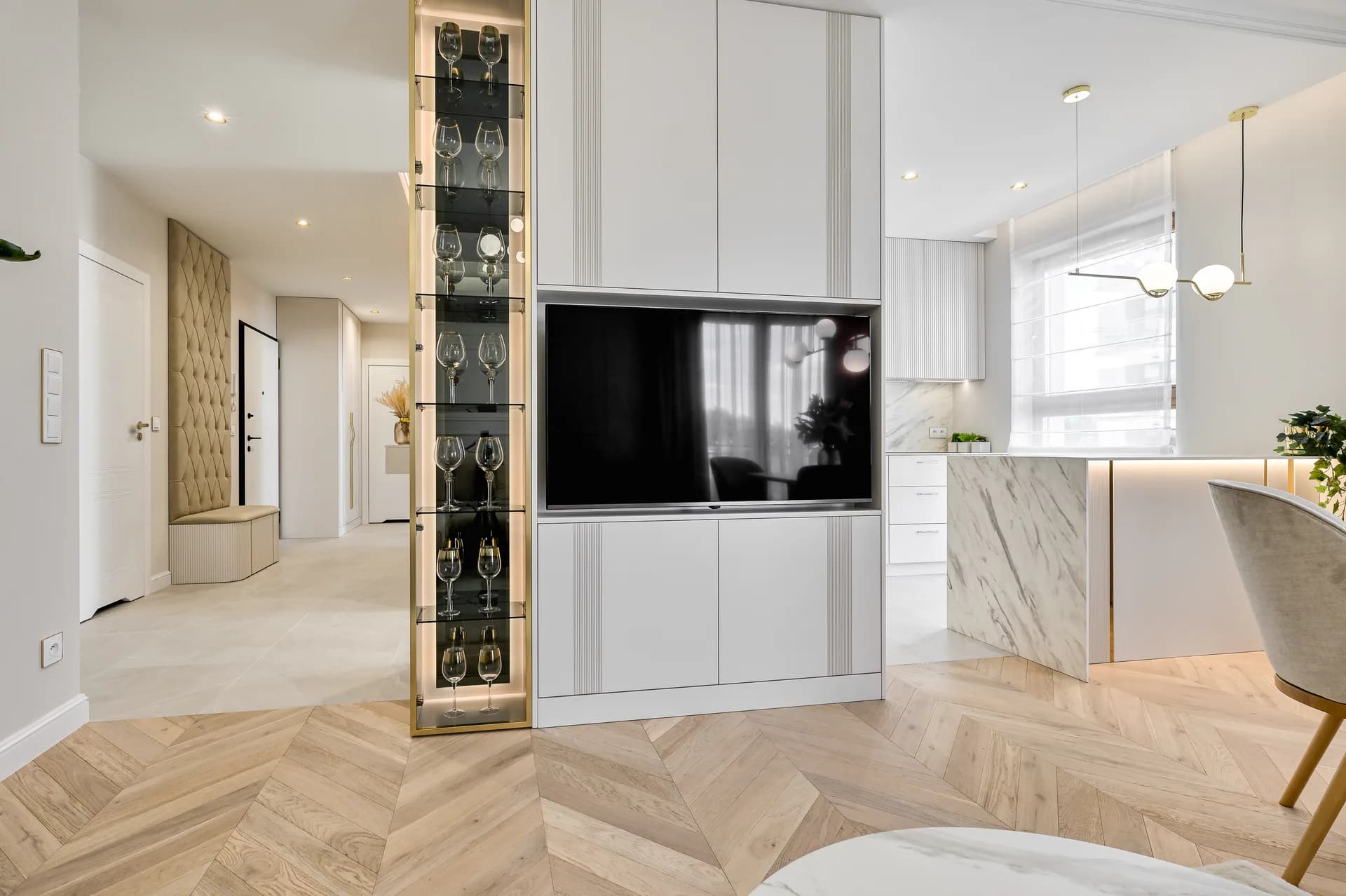
French herringbone: an elegant floor pattern for contemporary interiors.
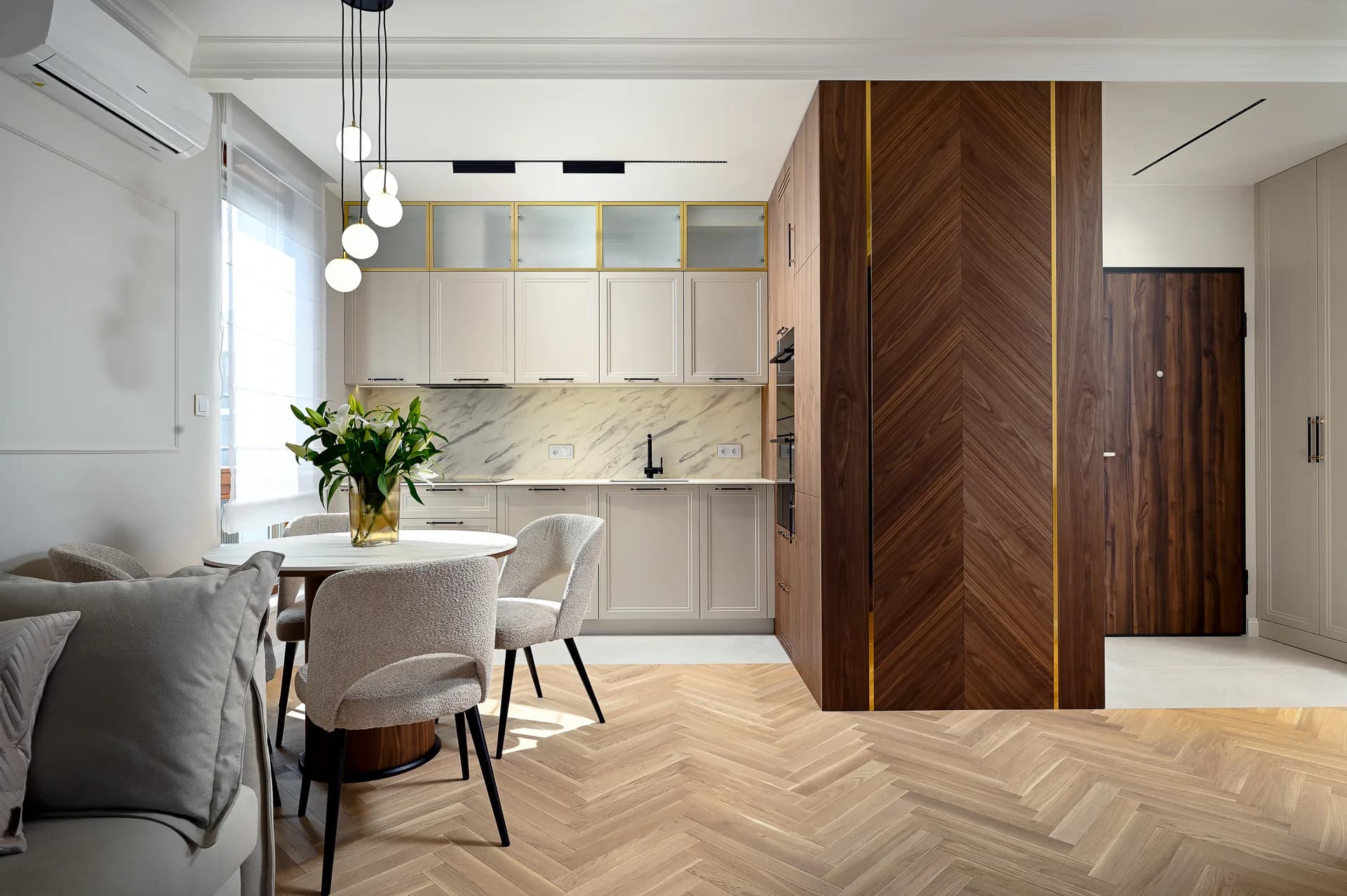
You can connect the kitchen and living-room floor in two ways: using one material throughout (SPC vinyl panels, wood-look porcelain tiles, microcement) or combining two…
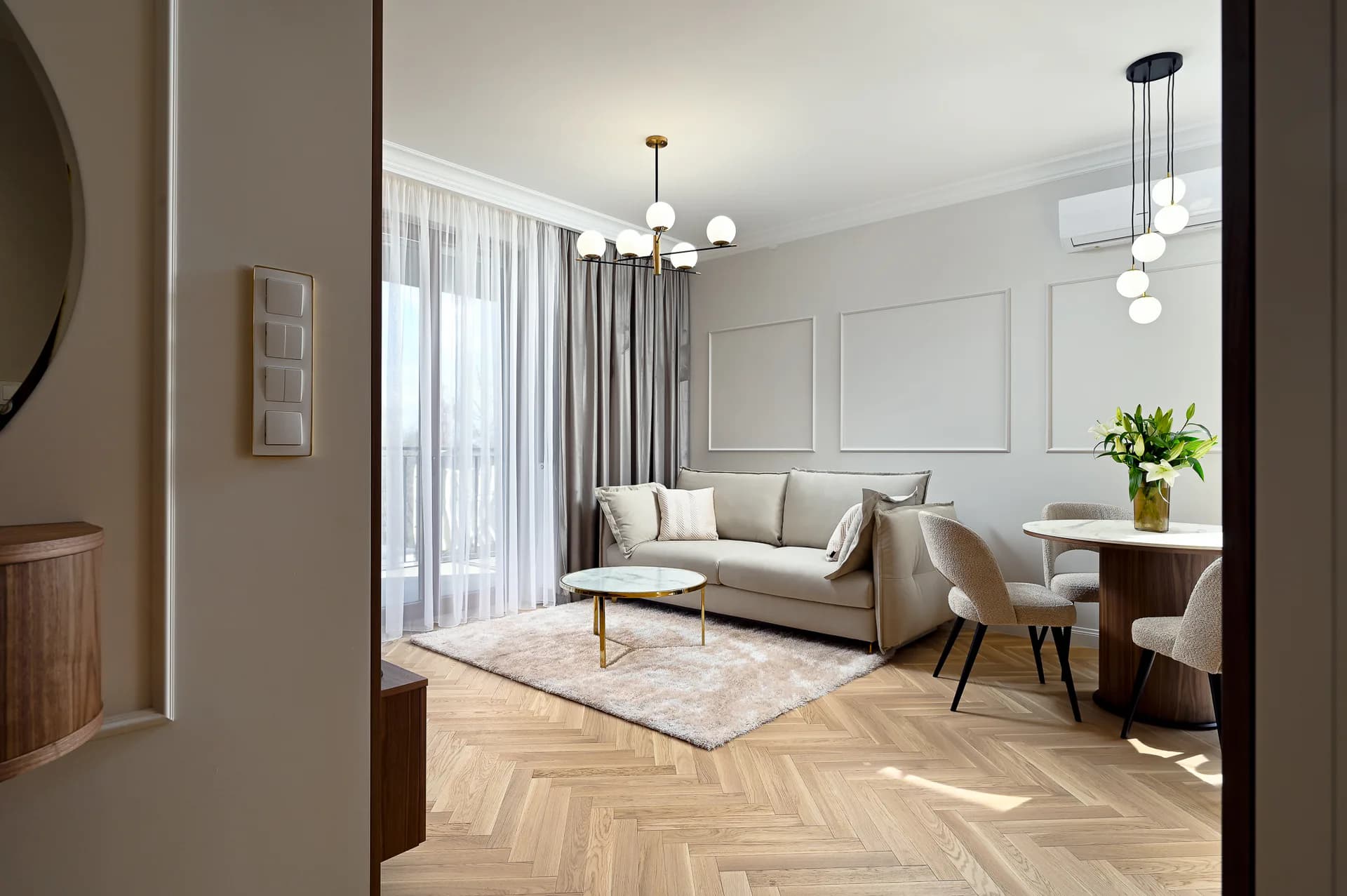
The best living-room floor is one that matches your everyday life — it not only looks beautiful on installation day but keeps its qualities for years…