

French herringbone: an elegant floor pattern for contemporary interiors
French herringbone: an elegant floor pattern for contemporary interiors.

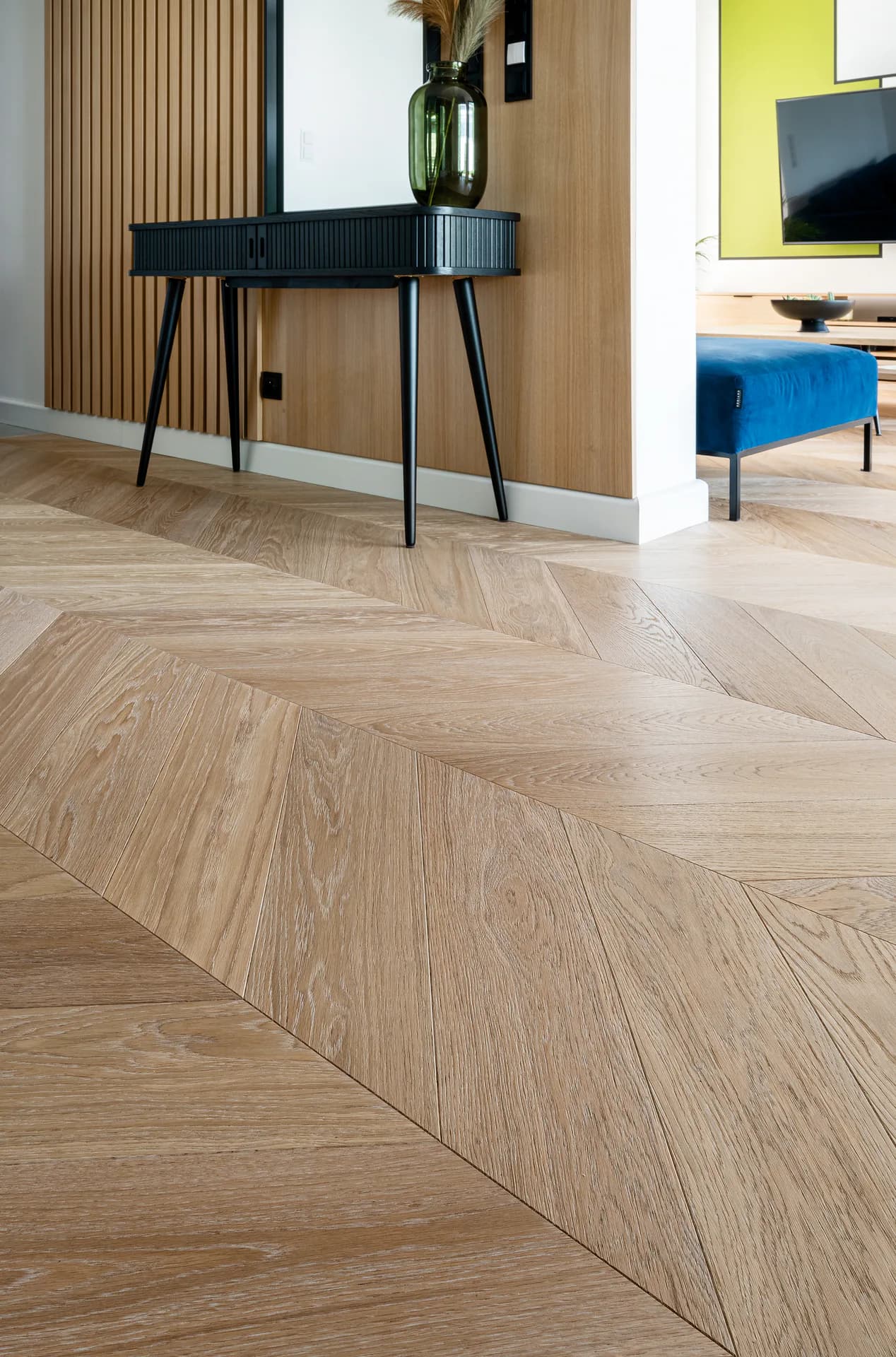
Parquet laying patterns determine whether a floor becomes a calm backdrop for the interior scheme or the main decorative feature of the room. The most frequently chosen are: brick bond, straight English bond, diagonal English bond, classic herringbone, French herringbone, Hungarian herringbone, chequerboard, mosaic and the palace pattern.
This article discusses the most popular parquet laying patterns used when installing wooden floors in flats, houses, apartments, studies and formal spaces. Bespoke artistic installations designed individually for a particular residence fall outside its scope, although references to palace patterns, coffers, basketweaves and rosettes will appear.
The article is intended for homeowners, investors, interior designers and anyone planning to lay a floor of wooden boards. Choosing a parquet pattern is a very important element of interior design, because it has an enormous influence on the look, the proportions of the room, the durability of the floor, the amount of material waste and the cost of labour.
In short: for small interiors the safest choices are brick bond, straight English bond or a fine classic herringbone. Spacious rooms suit French herringbone, Hungarian herringbone, diagonal English bond, chequerboard, mosaic and the palace pattern.
The most popular ways of laying parquet can be understood as follows:
After reading, you will find it easier to judge:
A parquet laying pattern is the way boards, blocks or small wooden elements are arranged in relation to one another, the walls, the light and the main axes of the room. It covers the direction of the boards, the offset of the joints, the cutting angle, the repeatability of the module and the relationship between horizontal and vertical runs of elements.
The significance of a pattern does not end with aesthetics. The arrangement affects the movement of the timber, its lifespan, the perceived geometry of the interior, the amount of material needed, the cost of laying the parquet and the difficulty of installation. A floor laid in long, straight runs can visually draw the eye into the depth of the room, whereas a chequerboard, mosaic or palace pattern focuses attention more strongly on the centre of the space.
Diagonal patterns, such as French herringbone, Hungarian herringbone or diagonal English bond, add dynamism and can visually correct proportions. An arrangement run across the width of a room can widen a narrow space, while one run along the longer axis can emphasise the perspective of a hallway or living room. The direction of the light also matters: boards run with the light usually give a calmer look, while a perpendicular or diagonal arrangement highlights the rhythm of the joints more strongly.
The history of parquet laying reaches back centuries, to the days when royal palaces and aristocratic residences were adorned with intricate wooden floors. Classic parquet compositions, such as herringbone or mosaic, were symbols of prestige and luxury in times gone by. Contemporary trends in parquet laying combine tradition with modernity, introducing innovative materials, precise installation techniques and ready-made elements suited to demanding patterns, including herringbone panels as an elegant flooring solution.
The simplest parquet laying patterns are brick bond and straight English bond. Brick bond is characterised by a simple, regular arrangement of floorboards, with the joints offset by half a board length relative to one another. In practice, the boards lie parallel to one another, and successive rows are offset by a half, a third, or in a freer fashion.
Straight English bond is one of the classic ways of laying parquet. It can have a regular offset or a more natural arrangement in which the joints fall more freely, yet still without visual chaos. Laying boards this way is easier than herringbone, requires fewer cuts and usually generates less waste.
Simple arrangements are cost-effective. Labour for patterns such as brick bond tends to be the cheapest, and the extra material required usually stays within around 5–10%. In smaller rooms this choice does not visually shrink the interior, and with light wood and a matt finish it works well with minimalist and Scandinavian styles.
Intermediate patterns include classic herringbone, the ladder pattern and chequerboard, which can be used not only on the floor but also as parquet on the wall – a modern interior decoration. Classic herringbone is one of the traditional and most recognisable wooden floor patterns, characterised by small blocks laid at a 90-degree angle, creating a striking zigzag. Often found in old townhouses, villas and elegant flats, this pattern bridges classic character and modern interiors with ease.
The chequerboard consists of squares made up of parallel strips rotated perpendicular to the neighbouring squares. The basketweave pattern, also known as chequerboard, is a composition in which boards are laid in squares, creating a striking, decorative pattern. This arrangement demands greater precision than brick bond, because the squares must keep their dimensions, line and repeatability.
The advanced patterns are above all French herringbone, Hungarian herringbone, mosaic arrangements and palace patterns. French herringbone, also known as Chevron, is characterised by boards laid at a 45-degree angle, which gives the floor a dynamic, modern look. Hungarian herringbone is similar, but usually has a gentler, more open angle and therefore a different visual rhythm.
Palace patterns are decorative compositions of various wood species, forming basketweaves and rosettes. Using them requires a very well prepared subfloor, precise cutting, moisture control and a detailed layout plan. That is why a closer look at the most popular patterns is best begun with the simplest arrangement, before moving on to herringbones, diagonal English layouts and decorative compositions.
The most popular parquet laying patterns differ not only in appearance but also in their technical requirements. The same wood species can produce a completely different effect in brick bond, herringbone and chequerboard. The various options are best weighed up together with the floor area, the interior style, the direction of the light, the board format and the installation budget.
Brick bond is one of the simplest and most universal patterns. The floorboards are laid in parallel rows, with the joints of successive rows offset, most often by half a board length. This gives the floor an orderly rhythm, though it is not as decorative as herringbone or chequerboard.
The greatest advantage of brick bond is its simplicity of installation. Compared with French herringbone or the palace pattern, it requires fewer cuts, less work on angles and a smaller material allowance. Brick bond is characterised by a simple, regular arrangement of floorboards, with the joints offset by half a board length relative to one another, which keeps it legible even in small interiors.
The brick bond pattern works well in minimalist and modern interiors. It pairs beautifully with simple, functional furniture, making it a versatile choice for a wide range of interior schemes. Depending on the direction of the boards, it can lengthen a room, bring order to a hallway or gently widen a space.
Brick bond suits the Scandinavian style, whose timeless simplicity harmonises with modern built-in furniture. It also works in minimalist, japandi and contemporary schemes, where the floor is meant to form a calm backdrop for the walls, joinery, furniture and natural light.
Classic herringbone belongs to the classic ways of laying parquet and remains one of the most recognisable wooden floor patterns. It involves laying blocks or boards so that the short edge of one block meets the long edge of the next. The result is a rhythmic arrangement at a 90-degree angle that creates a striking zigzag.
Classic herringbone can be laid with boards of a uniform size, and the wood species most often chosen for this pattern is oak. Oak offers good hardness, stability and a distinct yet not overly dominant grain. As a result, herringbone works just as well in old townhouses as in modern interiors with simple joinery.
The herringbone arrangement can distribute the stresses caused by timber movement more evenly, but it does not remove the need to maintain proper humidity conditions and to provide expansion gaps.
Herringbone suits the classic style, which evokes the luxury of old townhouses and villas and pairs well with antiques. In an oiled, matt version it is equally at home in the eclectic style, which is characterised by a dynamic pattern and suits interiors with soul and solid wood. In Glamour interiors, herringbone can create an elegant look when combined with lacquered wood, gold details and symmetry.
French herringbone, also known as Chevron, is characterised by boards laid at a 45-degree angle, which gives the floor a dynamic, modern look. Unlike classic herringbone, the ends of the boards are cut at an angle and meet along a single axis, forming a crisp, regular point.
French herringbone can visually widen or bring order to a space, although the effect depends on the proportions of the room and the way the pattern is laid out. The board format, the colour of the wood, the light and the direction of laying relative to the entrance and windows all play a part.
French herringbone is an elegant pattern that looks its best in formal spaces, where it can become the main decorative feature of the interior. It works well in living rooms, entrance halls, apartments, studies and large bedrooms. In spacious rooms a larger board format can be used, while in smaller rooms narrower elements and a calm colour palette are the better choice.
This pattern has higher installation requirements than brick bond and classic herringbone. The boards must be cut evenly, at a 45-degree angle, with repeatable lengths and stable moisture content. Labour can be noticeably more expensive and material waste greater, because the layout demands precise trimming at the walls and keeping the pattern on axis.
Straight English bond is based on laying boards parallel to one another. It is one of the traditional patterns, giving a calm, orderly look, and works well wherever the floor is not meant to compete with the furniture, joinery or wall decoration. It can be run along the room, across the room or with the main direction of the light.
Diagonal English bond is characterised by boards laid at a 45-degree angle to the wall, which lends it an elegant, luxurious look. A floor laid in diagonal English bond is ideal for modern apartments and spacious detached houses. The diagonal run of the boards brings more dynamism than a straight layout and can pleasingly break up an overly rigid room geometry.
Diagonal English bond, like straight English bond, relies on boards laid parallel to one another, but introduces an extra element of dynamism thanks to the diagonal layout. In practice this means more trimming at the walls and greater material waste. In return you gain a more striking, elegant look and an impression of greater depth.
Direction matters. Vertical runs of boards can visually lengthen an interior, horizontal runs can be used to visually widen a chosen zone, and a diagonal layout at 45 degrees works well when you want to draw attention away from uneven room proportions. In very narrow rooms it is worth sketching out the layout in advance, to avoid short, random terminations at the wall.
The chequerboard consists of squares made up of parallel strips rotated perpendicular to the neighbouring squares. The chequerboard pattern can be calm, when a single wood species is used, or highly decorative, when the squares differ in grain direction, shade or colour.
The basketweave pattern, also known as chequerboard, is a composition in which boards are laid in squares, creating a striking, decorative pattern. The basketweave draws the eye and gives an interior a unique character, making it an ideal choice for living rooms, dining rooms or studies. It looks best where the floor is meant to be seen, rather than hidden entirely under rugs or heavy furniture.
The basketweave pattern can be used with wood species that change volume under the influence of moisture, which minimises the risk of distortion. This is thanks to the alternating direction of the elements, which partly balances out the movement of the timber. It is still necessary, however, to maintain suitable room conditions and to execute the expansion gaps correctly.
Mosaic can be laid with small wooden blocks, short strips or larger modules. The palace pattern goes a step further: it combines different wood species, shades, basketweaves, rosettes and borders. The palace style comes into its own in spacious interiors, lending them a stately character. In modern projects such compositions are often paired with restrained walls, so that the decorative parquet does not compete with an excess of detail.
Once a pattern has been chosen, you need to assess whether it suits the floor area, the proportions, the budget, the wood species and the way the interior is used. Even the most beautiful pattern will not do its job if it is applied at the wrong scale, over a poor subfloor or without allowing for the movement of timber under the influence of moisture.
The size of the room matters, because the pattern changes how proportions are perceived. The same parquet will look calm in brick bond, more elegant in classic herringbone and far more decorative in a chequerboard. The smaller the floor area, the more carefully large modules, contrasts and very wide boards should be chosen.
For smaller rooms the best choices are:
For medium-sized rooms of 20 to 40 m² you can consider:
For large spaces above 40 m² good options include:
The proportions of the room are just as important as the floor area itself. Narrow rooms can be visually widened with a crosswise layout or a diagonal pattern. Long hallways take runs laid along their axis well, but where the tunnel effect is too strong, herringbone or a diagonal layout is the better option. Nearly square rooms take chequerboard, mosaic and symmetrical compositions well.
The technical differences between patterns concern precision, waste, labour cost and the risk of errors. The more angles, short elements, repeats and axes of symmetry, the more the quality of the subfloor and the experience of the installer matter.
| Pattern | Installation difficulty | Cutting and layout precision | Material waste | Labour cost relative to a simple layout |
| Brick bond | low to moderate | basic, boards parallel to one another | usually around 5–10% | the lowest, the point of reference |
| Straight English bond | low to moderate | basic, the joint offset matters | usually around 5–10% | similar to brick bond |
| Classic herringbone | moderate | an exact 90-degree angle and a straight starting axis | usually moderate | often around 20–40% higher |
| Diagonal English bond | moderate to high | cuts at the walls at a 45-degree angle | greater than with a straight layout | higher due to diagonal trimming |
| French herringbone | high | boards cut at a 45-degree angle, repeatable length | often around 15–25% | can be around 50–100% higher |
| Hungarian herringbone | high | exact angles and consistent module geometry | similar to angle-cut patterns | close to chevron |
| Chequerboard and mosaic | high to very high | squares, grain direction, modules | increased, depending on the module | markedly higher |
| Palace pattern | very high | rosettes, basketweaves, borders, multiple wood species | high | many times higher for decorative projects |
For an economical budget, brick bond and straight English bond are the best options, especially if you take advantage of wooden floors on promotion. For an interior where an elegant look and durability count, classic herringbone is a good compromise. For formal spaces, apartments and living rooms where the floor is meant to draw attention, French herringbone, Hungarian herringbone, chequerboard, mosaic or the palace pattern are worth considering.
Oak is the most universal choice for parquet. It offers good hardness, stability and a wide availability of formats, so it suits brick bond, English bond, classic herringbone, French herringbone and palace patterns. For classic herringbone, oak is especially popular, because it withstands years of use well and can be renovated many times over.
Ash works well where the grain of the wood is to be emphasised more strongly. It has an expressive grain, good hardness and a modern look, so it suits herringbone, diagonal English bond and light Scandinavian schemes. In small interiors it is worth being careful with very high-contrast batches, as they can visually crowd the floor.
Beech offers a calmer colour palette, but reacts more strongly to humidity conditions, so it requires a stable indoor climate. It can be used in simpler patterns, such as brick bond or English bond, provided the subfloor and the room's climate are well controlled.
Exotic wood species, such as teak, iroko, merbau, kempas or wenge, are used more often in premium schemes and decorative compositions, as is the wide range of Kaczkan wooden floors. Wenge can create a strong contrast in a mosaic or palace pattern, but it calls for a considered choice of wall colours, furniture and lighting. With exotic species, particular attention must be paid to volume changes under the influence of moisture, the right adhesive and the stability of the material.
The choice of wood species ties in directly with installation challenges. The more complex the pattern and the more the material moves, the more important are: the moisture content of the wood, the evenness of the subfloor, the acclimatisation of the boards, correct expansion gaps and cutting accuracy.
The most common problems when laying boards stem not from the pattern itself, but from a mismatch between the pattern and the conditions. Uneven walls, fluctuating moisture levels, too small a material allowance or a poorly chosen board width can rob even an expensive parquet floor of its looks and durability.
Uneven walls cause the least trouble with simple layouts, such as brick bond and straight English bond. These patterns are easier to correct at the skirting, with trims and by shifting rows. With French herringbone, diagonal English bond, chequerboard and the palace pattern, deviations from a right angle become visible much sooner.
Compensation techniques include setting out the axes of the room, starting the installation from the most visible line, sketching out the layout in advance, sorting the boards and using masking trims where the floor ends. With showpiece patterns it is better not to run the layout blindly off a crooked wall, because the error will grow with every successive row.
Patterns that demand precise dimensions, such as French herringbone, Hungarian herringbone, chequerboard and mosaic, need elements of repeatable length, thickness and cutting angle. Even small deviations can create gaps, shifted axes or uneven squares.
With simple patterns, a material reserve of around 5–10% is usually planned. With French herringbone, diagonal English bond, mosaic and the palace pattern, an allowance of around 15–25% is safer, because more material goes on angled cuts, grain selection and colour matching. Buying boards from a single production batch limits differences in colour and dimension.
Wood moves under the influence of moisture, so every pattern requires expansion gaps at walls, thresholds and fixed elements of the fit-out. A typical gap at the walls is around 10–12 mm, although the exact value depends on the board format, the floor area and the recommendations of the installation system.
Complex patterns are not exempt from the technical rules. Classic herringbone can reduce timber movement and prevent warping thanks to the alternating arrangement of its elements, but it still requires stable conditions. The recommended air humidity in an occupied interior is usually around 40–60%. Air that is too dry causes gaps, while excess moisture can lead to swelling, lifting and distortion.
To increase the durability of a parquet floor, you need to ensure an even subfloor, timber acclimatisation, the right adhesive, a suitable finish and regular care. Only then will the pattern, whether it is brick bond, herringbone or chequerboard, keep its looks for years.
The safest choice depends on the floor area, the style, the budget and the desired effect. Brick bond and straight English bond are calm, economical and universal. Classic herringbone gives an elegant look, good durability and suits many schemes. French herringbone, Hungarian herringbone, diagonal English bond, chequerboard, mosaic and the palace pattern are more decorative, but demand greater precision and a higher budget.
If you are planning to lay parquet, take the following steps:
Consulting a professional is particularly worthwhile for French herringbone, Hungarian herringbone, diagonal English bond, mosaic and the palace pattern, drawing on the advice offered by the Europarkiet showroom in Warsaw. In these layouts, errors in cutting, axes and expansion gaps are more visible and more expensive to put right.
Interior design trends show a strong return of herringbone in old townhouses, apartments and new houses. At the same time, simple, natural wooden floors in minimalist and Scandinavian styles are growing in popularity. The best projects combine traditional patterns with a modern finish, good material quality and the right scale for the interior.
In small interiors, brick bond, straight English bond or a fine classic herringbone work best. Brick bond is a particularly safe choice, because it does not visually shrink the room and pairs well with simple, functional furniture. If you want a more decorative effect, laying a wooden floor in French herringbone can visually widen the space, but it requires suitably narrow boards and a calm colour palette.
Brick bond and straight English bond are usually the cheapest to install, with labour costing roughly around 80–120 zł/m². Classic herringbone often raises the cost by around 20–40% compared with a simple layout. French herringbone, diagonal English bond, mosaic and the palace pattern can increase labour by around 40–100% or more, because they demand greater precision, more trimming and careful material selection.
They can, but it is best done deliberately, with a clear division into zones. For example, classic herringbone can appear in the living room, with straight English bond in the hallway or bedroom. In formal spaces, the palace pattern can serve as a central accent, with a simpler layout by the walls. It is important to keep the same material thickness, a consistent colour palette and correct expansion gaps between the zones.
The easiest to maintain are the simpler layouts, such as brick bond and straight English bond, because they have fewer complicated joints and are easier to renovate locally. In terms of stability, classic herringbone performs very well. A floor laid in herringbone is more resistant to distortion, which translates into a long life, and it also reduces timber movement, preventing warping.
Oak is best suited to herringbone, because it offers good hardness, stability and a universal look. Classic herringbone can be laid with boards of a uniform size, and the wood species most often chosen for this pattern is oak. Ash can also be a good choice, especially if you want to emphasise the natural grain. With exotic wood species, moisture levels and installation conditions must be controlled closely.
We will advise and prepare an individual quote matched to your interior.
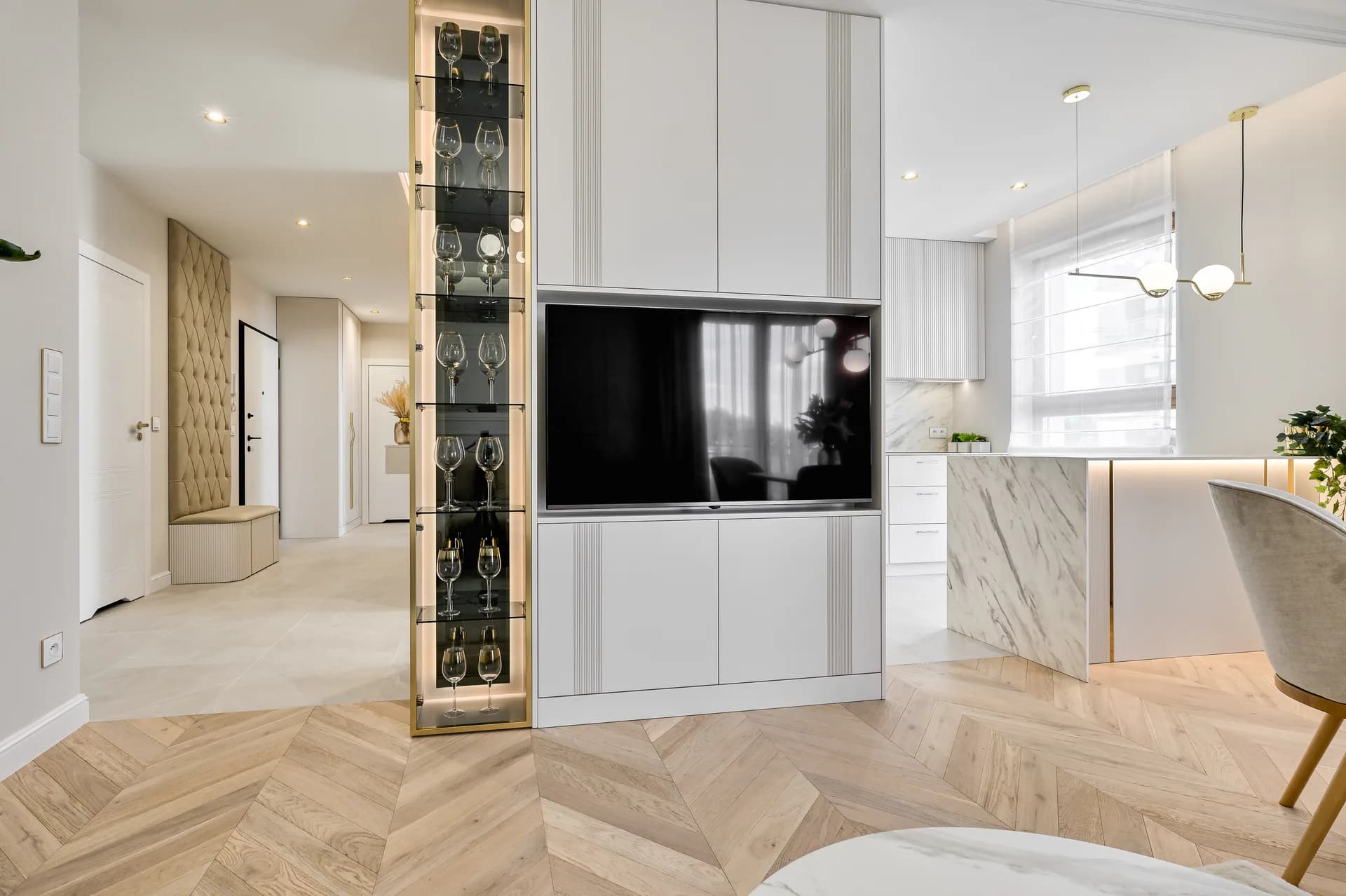
French herringbone: an elegant floor pattern for contemporary interiors.
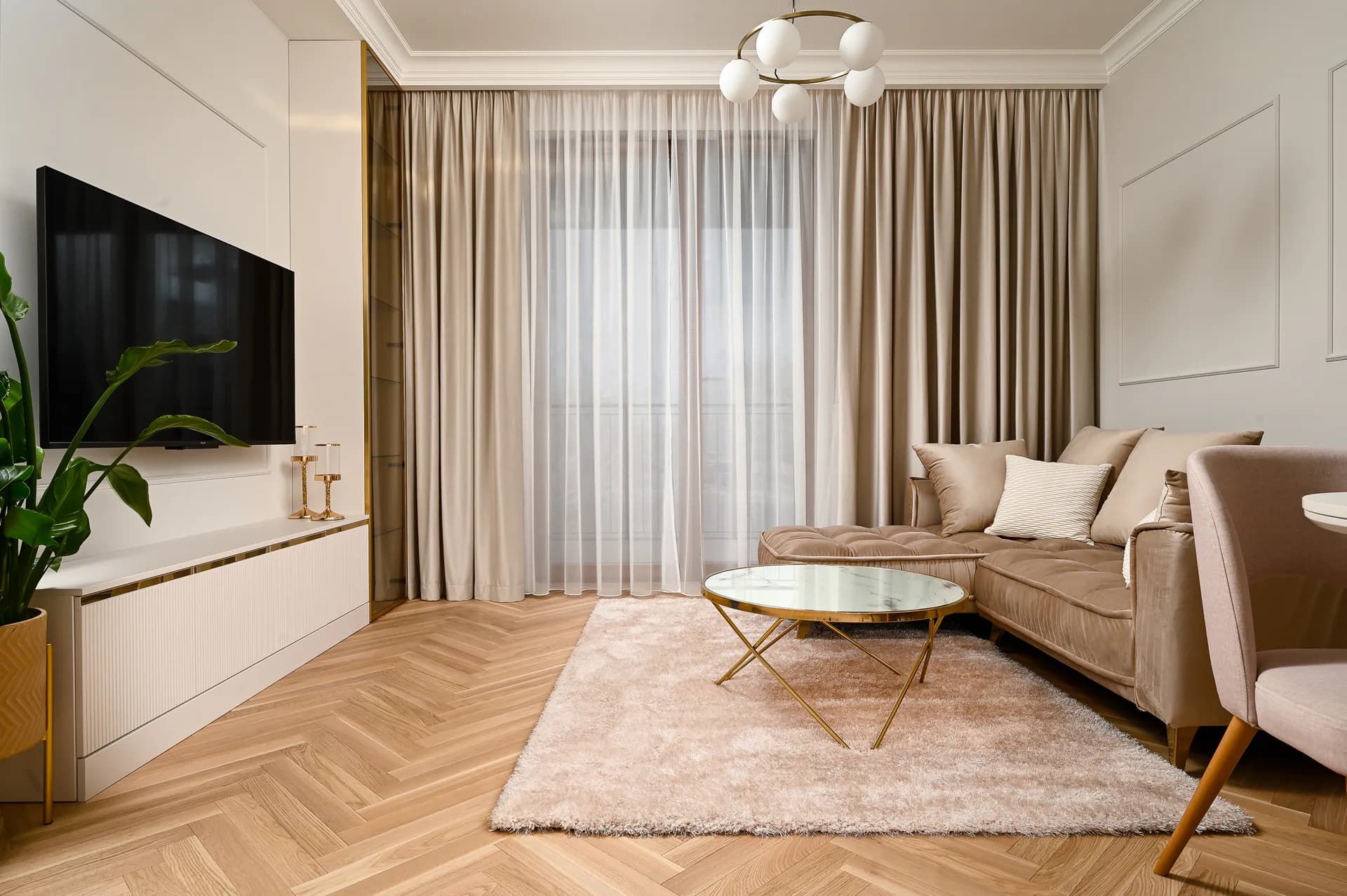
Classic herringbone is one of the most timeless flooring patterns, at home in traditional and contemporary living rooms alike…
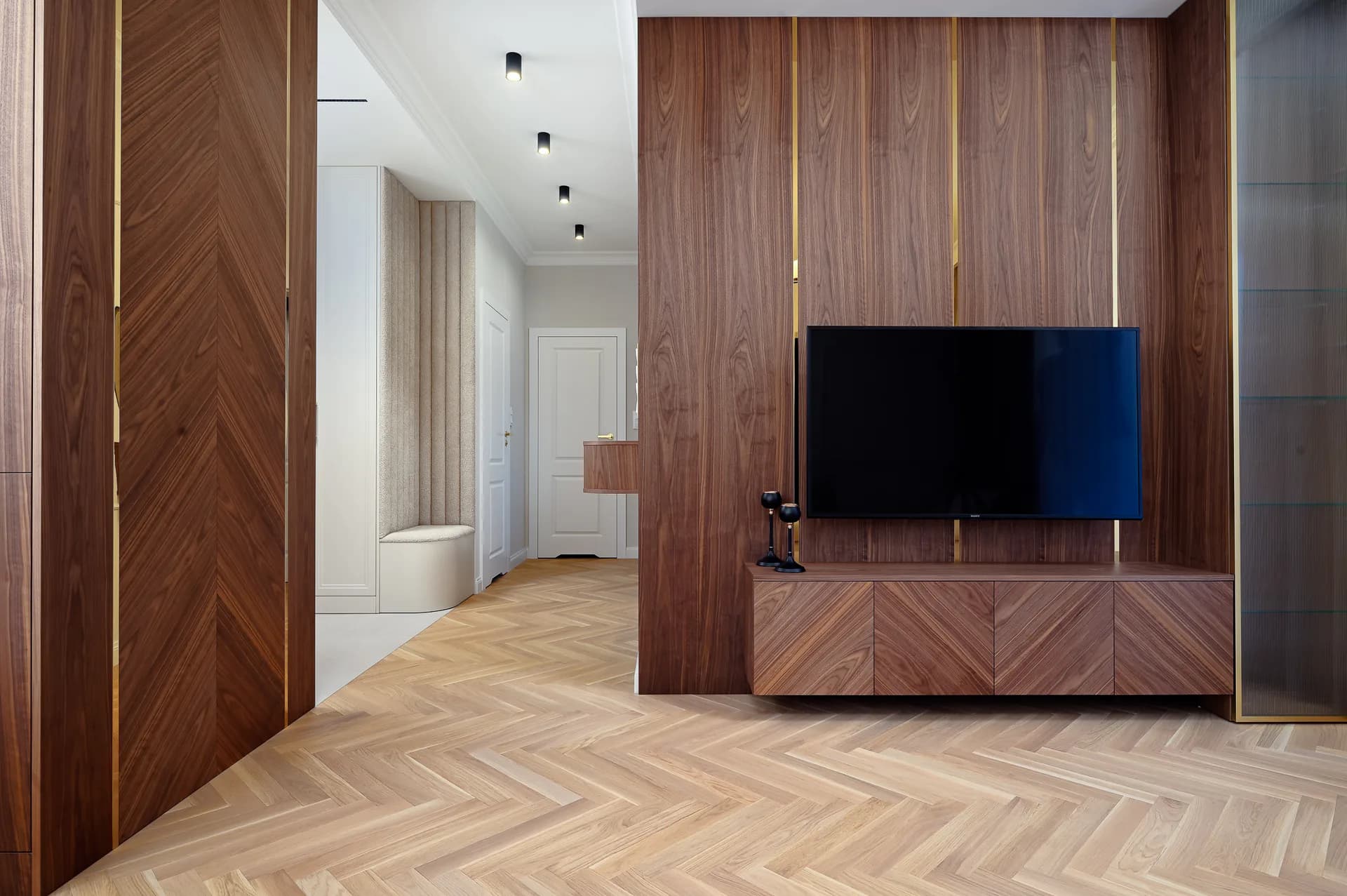
Wooden parquet and engineered boards can be used successfully with underfloor heating, provided the material, construction and installation method are chosen correctly…